
You speak at roughly 150 words per minute. You type at about 40. That's not a minor efficiency gap — it's a 3x difference in throughput, and after error correction, the gap widens to nearly 4x. Stanford's HCI lab found speech input produces 20% fewer errors than typing in English.
The world is catching up to this math.
WhatsApp processes on the order of 7 billion voice messages every single day — Meta cites this scale when describing global messaging volume. Voice isn't a fringe input; it's how billions of people already talk to each other.
Every Zoom call now asks if you'd like an AI summary. Otter.ai generates over $1 billion in annual ROI for its enterprise customers by turning meeting audio into structured notes. 42% of millennials say messaging has replaced most of their phone calls — and millennials are the generation most likely to send voice notes. In the workplace, AI transcription went from novelty to assumed infrastructure in under two years.
Voice as input isn't a prediction anymore. It's already happening — in meetings, in messages, in cars, in kitchens. What hasn't happened yet is voice as the foundation for social connection.
That's what Bonzai is building. And it's harder than it looks.
The Bet: Voice as Social Input
Every social platform ever built has asked users to create content. Type a post. Shoot a photo. Record a polished video. The result: the top 25% of users produce 97–98% of all content on every major platform. Most people — especially millennials and Gen X — stopped participating years ago.
Bonzai asks for something different: talk about your day.
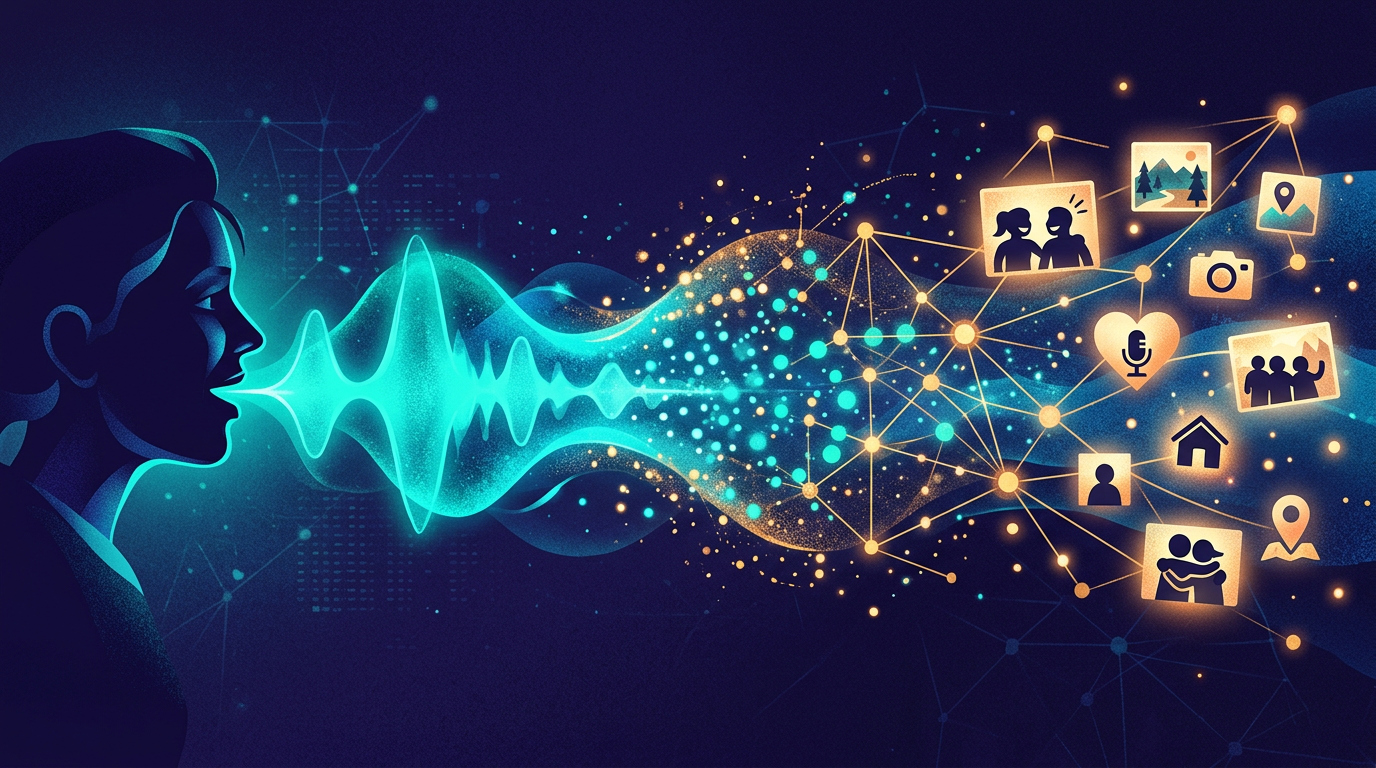
Not to an audience. Not as a performance. Just a voice note — 30 seconds about the tacos you made, the conversation you had with your kid, the fact that you skipped the gym again. The system takes it from there: transcription, memory extraction, importance scoring, and eventually, beautifully rendered daily news that your closest friends actually want to read.
The input is low-friction by design. Speaking is what humans are wired to do. You don't plan a voice note. You don't edit it. You don't wonder if it's good enough. You just talk.
But underneath that effortless input is a pipeline that has to solve problems no meeting transcription tool or voice assistant has ever needed to.
The Pipeline: From Sound Wave to Structured Memory
Here's what actually happens when you record a 30-second voice note in Bonzai:
1. Capture and durability. The app records AAC audio at 16 kHz mono — optimized for speech clarity, not music fidelity. Every recording is written to a durable pending queue on device before upload begins. If the upload fails (tunnel, airplane mode, dead zone), a recovery service retries with backoff until the note reaches the server. No voice note is ever silently lost.
2. Transcription. The audio file lands in the cloud and kicks-off an automatic transcription pipeline. Our models also include per-user vocabulary boosting: if you talk about "Bonzai" or your friend "Aoife" regularly, the model learns to hear those words correctly.
3. Memory creation. When the transcript arrives, it doesn't just get stored — it gets understood. This is where Bonzai's secret sauce lives. The system runs a parallel enrichment pipeline that extracts and maps dozens of data points from a single voice note — scoring, classifying, indexing, and cross-referencing against everything it already knows about you. A 30-second recording becomes a fully enriched, contextually aware memory in seconds. We won't detail every layer here, but the result is a system that doesn't just record what you said — it comprehends why it matters.
4. Downstream intelligence. The memory doesn't stop at storage. After the initial commit, a cascade of post-processing kicks in — asynchronous analysis layers that deepen the system's understanding over time. The AI extracts durable facts from what you said ("Jeff has a brother," "Jeff works in Los Altos," "Jeff's friend Andrew drinks oat milk"), resolves ambiguous entities, identifies relationship signals, and feeds everything back into your evolving personal model. Each voice note makes the system smarter — not just about what happened today, but about the structure of your life.
That's the pipeline. It looks straightforward written out like this. It isn't.
The Hard Problems
Casual speech is terrible data
Meeting transcription tools have it comparatively easy. Meetings have structure — agendas, turns, formal speech patterns. Voice notes from someone walking their dog sound like this: "So yeah I saw Marcus today, first time in like months, we got tacos at that place — not the one on Mission, the other one — anyway he's thinking about moving which is kind of wild."
One voice note. Embedded inside it: a relationship signal (Marcus, met in person), a temporal signal (first time in months), a geographic hint (tacos at a specific place), a forward-looking event (thinking about moving), and an emotional register (kind of wild). The system has to hear all of that.
Classical NLP would choke on this. There are no complete sentences. The referents are ambiguous ("that place," "the other one"). The emotional weight isn't in any single word — it's in the contrast between "months" and "first time." This is the kind of language humans use when they're not performing, when they're just talking. It's the most natural input humans can give, and the hardest to process.
One voice note, many memories
A user says: "I went to the gym this morning, then had coffee with Sarah, and I'm thinking about looking for a new apartment." That's three distinct life events in one breath — an activity, a social interaction, and a major life consideration. Each one carries a different importance score, different entity associations, and different downstream behaviors. Bonzai's memory system untangles these — splitting a natural language stream into discrete semantic events while preserving the context that spans them. The gym visit is routine. Coffee with Sarah is a relationship signal. The apartment thought is a life-stage marker. The system hears all three, scores them independently, and connects them to everything it already knows about you.
Personalized vocabulary is essential
Even the best speech-to-text models are general purpose. They're trained on English at scale. They don't know that "Bonzai" isn't "bonsai." They don't know that your friend's name is "Aoife" not "Eva." They don't know your workplace jargon or the nickname your college roommate goes by.
Bonzai solves this with a personalization layer that adapts transcription to your life. The system builds a per-user language model that evolves as it learns about your world — the names, places, and terms that matter to you. Every transcription is shaped by what the system already knows. This is a quiet feature with an outsized impact on trust: nothing breaks the spell faster than your friend's name consistently misspelled.
Importance is subjective and contextual
"Went to the gym" is a mundane entry for someone who goes every day. For someone who hasn't been in two months, it's a breakthrough. Bonzai's importance engine doesn't just score what you said — it scores what you said relative to everything it already knows about you. The system maintains a living model of your behavioral patterns, so it can distinguish routine from revelation. That contextual scoring changes everything downstream: what gets surfaced to friends, what gets emphasized in the daily news, and what the system decides is worth remembering at all.
Timing is trickier than it sounds
When someone records a voice note at 8 PM about something that happened at lunch, which timestamp matters? The recording time? The event time? The server processing time? The system needs to reason about all three for different purposes: the recording time for deduplication, the event time for narrative ordering, the processing time for pipeline sequencing. Today, voice notes carry their recording timestamp from the device. But the event time — the actual moment being described — is locked inside the natural language and requires inference to extract.
Why This Matters
The reason voice works as social input isn't just speed. It's that voice captures what typing filters out.
When you type a message, you edit. You delete. You reconsider. By the time you hit send, you've compressed your experience into something that feels appropriate for the medium. Voice doesn't work that way. You start talking and the texture of the experience comes through — the pauses, the hedging, the enthusiasm, the offhand details you wouldn't have thought to include in a written post.
Those details are exactly what creates closeness. Knowing your friend is "kind of obsessed with this podcast" is more connecting than knowing they "listened to a podcast." The emotional texture is the signal. Voice preserves it. Typing destroys it.
This is the core thesis: voice is the only input modality that matches the actual texture of a human life. And when you pair that input with AI that can listen, infer, remember, and narrate — you get something no social platform has ever had. Not a broadcast tool. Not a messaging app. A system that knows what your life sounds like and can tell the people who care.
We're building Bonzai for the generations that remember what closeness felt like — and are ready for something that actually brings it back. Voice is how it starts. Everything else follows from there.
The future of sharing isn't posting. It's talking.
